Showing posts with label Ernakulam Journeys. Show all posts

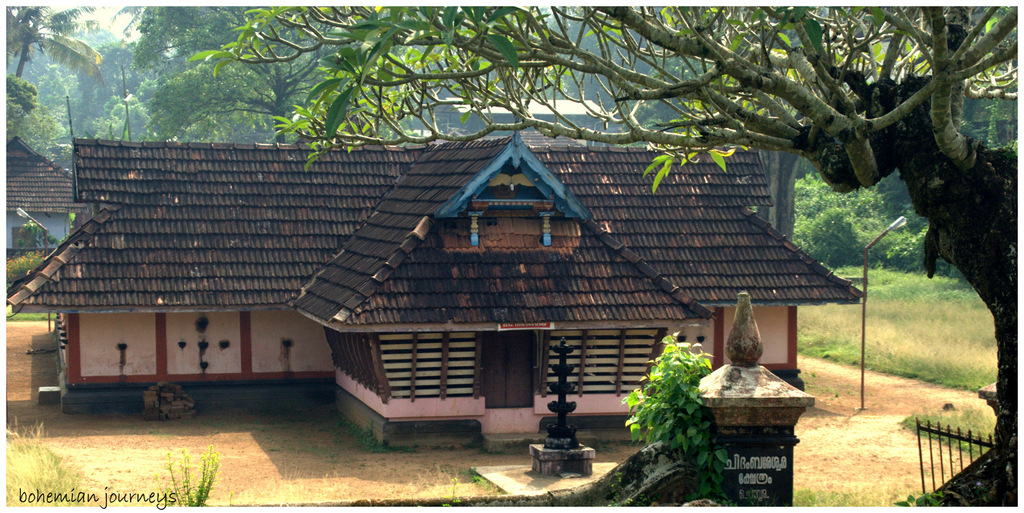
Chirakkal Mahadeva Temple, Puliyanam, Angamaly, Ernakulam Dist.

Chirakkal Mahadeva Temple, Puliyanam
The vibrant Angamaly town, 30km from Kochi, is already busy when we reached there by early morning. Under a partly cloudy sky vehicles are breezing past as if to catch up with fleeting life. Vendors are seen getting on with their morning business and people are starting about for the day’s labor. Surroundings already molded into a typical Indian street canvas. We got down at the junction and waited at the bus stop for the journey ahead.

As we waited, from a building opposite to us we heard repeating siren. A man standing close to us in the bus stop said  “It is the siren for every hour. The clock never shows right time, and the siren is scary, as you can assume it is our municipal building.” We smiled at him wondering from where they manage to get these kind of instruments! 

There are few local dwellers around who too are waiting for the bus - “Will we get bus to Chirakkal from here?”, I checked. “Yes, just wait for a while. Bus will stop here” we thanked him and continued our wait. In a while, we got our bus, an old model private bus, to the destination of the day - Chirakkal Mahadeva Temple

Puliyanam Bus Stop

From Ilavoor junction, the bus soon took a turn from crowded highway towards Puliyanam. In a while the surroundings changed - there came a serene greenery around, we felt fresh air to breath, found more space to feel and in fact sensed more time in life! – yes, a journey from materialism of town to serenity of village is so tranquil! Our bus took us around 8 km inside and finally we got down at Puliyanam government school stop. A simple and sedentary surrounding welcomed us. The signboard down a road gave us the directions. We walked around half a kilometer along that uneven road surrounded with homes. Just as we were about to reach the temple, Tripthi found her footwear damaged. We kept it on the roadside and walked barefoot to the abode of the Lord.

The entry to the temple via the road is from the West. Lord Siva here is facing East. The temple, in Kerala architecture, is completely renovated but the concrete culture has taken out the traditional aura from the structure. “How true is it that when artificial-man-made compounds get into construction, it takes out life and divinity in it.”, Trips commented. “Not just construction, it is true in everything!”. Without Dwaja or Gopuram, the temple has no ancient vibes around it, yet the large Balikallu stands as a reminder of its rich old days. Inside the Valiyambalam, the square Sreekovil is two storied and the Lord is consecrated in Rowdra bhava. There is no Devi prathista in the temple. There is a namaskara mandapa in front with Nandi idol. On the North there is Ganapathi and on the outside, there is a subshrine of Sastha and Devi.


Towards the east side, we see a grass rich pathway which takes us to a large pond (Chira in Malayalam), probably an indication to the temple’s glorious past. We walked down to the pond and standing there our mind traversed back to its past – this might have been a grand pond surrounded with green grass and tall coconut trees, around it there might have been those meandering cows, and from the distance we could be seeing the big temple, stone built with traditional architecture and with the people walking around in their antique styled costumes and with a hairstyle with a tuft!

Path to Chira

After spending some time near Chira, we walked back and on the way out talked to one of the temple administrator - “Astrologers state that in the Chira the old flagpost and vessels of this temple are still lying deep in it. Also, since Lord Shiva here is in Rowdra Bhava the view of this Chira is what cools down the power. Hence the Chira is kept intact. This temple might have got destroyed during Tipu’s raid. Moozhikulam temple is nearby which also was destroyed then. And all these areas around which you see when you walk down were part of temple compound. At some point in time most of those got appropriated by people. Now lawsuits are going on for it.”


It is considered this temple was under Chirakkal Kingdom which was a branch of Kolathiri dynasty who were descendants of Cheras. For reasons unknown, the temple later came under Alangad Kings which further came under Travancore Kingdom. Finally now, the temple is managed by Travancore Devaswam Board. Tantram is with Badrakaali Mattapilli Mana. Temple has two poojas and Sivarathri is celebrated with the support of people around this temple.


Spending almost an hour in the temple and its surroundings, we started our journey back feeling the gentle breeze from the east Chira with the hymns of Sreerudra in the backdrop.

Footnote : 

References : 108 Sivakshetrangal (Malayalam) - Kunjikuttan Ilayath

Chidambareswara Temple, Chowarra, Ernakulam Dist., Kerala


It is a long wait in the bus stop at Kodungallur. The morning feel is fast fading as the summer heat is getting on us. How long we will have to wait? Will we reach our destination on time? Should we call off our plan? All kinds of thoughts are running through just as we saw the bus coming down in the nick of the time.

Yet again, as experienced an umpteen number of times, that eternal power pulls us back into the path of our life from the edge of our indolence. Once started, our journey was like a well orchestrated cruise! As soon as we reached Parur, we found our bus to Alvua. Getting down at Aluva came the bus to Kalady all in frequent succession. Just as the bus took the turn to the Aluva-Kalady road, the thoughts of summer heat evaporated out. It was pleasing journey along Periyar surrounded with rich flora as we reached our destination of the day, Chowarra Chidambareswara Temple - much earlier than expected.


Chowarra, though now a nondescript place, was once the summer capital of Cochin Kings who ruled this area. Cochin King Sri Rama Varma XV (1895-1914), known as Rajarshi established Chowarra Head Water Works in 1905 to purify and distribute the Periyar water for Cochin and Ernakulam. Once there was ferry service at Chowarra which connected Kochi and Travancore states. The railway at Chowarra was also made possible by the efforts of Cochin Royal Kings. King Sri Rama Varma XVII, known as Dhaarmika Chakravarthi, who passed away at Chowarra had written many anecdotes about Saktan Thampuran while being at Chowarra. His statue is the one which adorns the Tripunithura East side Junction. 


None of those Royals insignia no longer exist now. Neither are there any royal summer homes. The thickening concrete structures around has its impact on the environment too. Yet only solace we felt is a certain degree of tenderness of all that bygone era!

In the legends, of the 64 villages created by Lord Parasurama, Chowarra is one village and is considered as an important one. The word "Chowaram" means the "Centre of Siva". In the 108 Sivalaya Stotra, the name comes in the second line - "Sucheendram Chowaram Mathoor Trippangotta atha Mundayoor". It is considered the "Chowaram" mentioned in the strotra refers to the present day Chowarra and Sivalaya here is the Chidambareswara Temple!

Chidambareswara is a very small temple situated along the roadside in a slightly lower plane. As we walk down, we find the entry to temple has been modified from what we had seen when we visited here around five years back. Though the historical details of this temple are not known, based on the presence of Cochin Kings in the surrounding areas in yesteryears, we can assume the Royal family had close connection with this temple. 

The old entry to the temple. This is now renovated.

It is considered the idol in this temple was brought from Chidarmbaram for consecration. The temple, irrespective of its name, is of small proportions and do not have any similarities to Chidambaram temple in the rituals or surroundings. Entry takes us along the Balikallu to the inside of the temple. Lord Siva is facing West and is considered as Kirathamoorthy. Only upadeva inside the temple is Lord Ganesha. On the outer side, there are Nagas. Two poojas are done daily in this temple. The festival is in the month of malayalam month Makaram (Jan-Feb). Currently the temple is handled by Cochin Devaswam Board.


We read the legendary Cochin King Saktan Thampuran was born at Vellarapally which we assumed to be around this temple. We wandered through those areas around Chowwarra and found a royal house which probably could be the birth home of Saktan?! We couldn't confirm it. The house we found is currently rented and the people occupying it have no idea about any of the history or mystery around it. Yes, it did disappoint our wandering history buff minds! But in all our uncertain trails of this kind we always remind ourselves - All those wander are not lost - especially those wanderers who are sparked and carried by that eternal power!

Pazhoor Perum Thrikovil, Ernakulam Dist., Kerala


Pazhoor Perum Thrikovil - view from hanging bridge

"Paarivaloor Adattum nal Parippil Chathamangalam" – from 108 Shivalaya Nama Stothra

Paarivaloor - it is believed this place of bygone era has now transformed into the present day village of Pazhoor near Piravom in Ernakulam District of Kerala. As in all our customary journeys, we started early in the morning from Tripunithura to our destination of the day – Pazhoor Perum Thrikovil. For a change, this time the route is winding down along Mamala-Sasthamugal through dense rubber plantations. The incessant shrill of crickets is following us all along the way. The overnight rain and cloudy sky gives an ambience of a jungle even though there are several houses around. Yes, the whole feel reflects the essence of Pazhoor village which is rich in its legends and myths!

One such legend is about the family of astrologers renowned as Pazhoor Padipura which has its history dating back to 1200 AD. This family has its roots to Talakulath Govinda Bhattathiri, a famed astrologer known for incredible accuracy in his predictions. The mortal body of this Bhattathiri was entombed below the Padipura (Gate-house of Namboothiri Illams of Ancient Kerala) as per his wish. It is believed the presence of his soul is still there and the predictions made inside the Padipura by the family members will be precise. Pazhoor Padipura is still considered to be the last word in Astrology.


Pazhoor Padipura - Last word in Astrology
Once a Namboothiri came to the astrologer of Pazhoor Padipura to check his horoscope. Astrologer found the warning of immediate death in that horoscope. Instead of disclosing it, he advised the Namboothiri to come back the next day. Namboothiri unaware of his predicament went to Lord Siva temple across the lake and spent that night there. At that time the temple was in a dilapidated state. The Namboothiri while sleeping decided in his mind that the temple should be renovated. The next day Namboothiri went back to the astrologer. The astrologer was surprised to see the Namboothiri back who he thought would have died by then. On understanding the stay of the Namboothiri in Siva temple and his subsequent decision to renovate the temple the astrologer said: "You would have died yesterday as per your horoscope. But Lord Siva has blessed you as you have embarked on a great divine activity. There is no need to check your horoscope. You will live till the temple is renovated and further on till the Sathaabhishega is done!” - Lord Siva who blessed that Namboothiri is still blessing the devotees at Pazhoor Perum Thrikovil as Perum Thrikovilappan.
Pazhoor Padipura - The Astro-Ground ! 
It took hardly an hour for us to reach the temple from Tripunithura which is along the Arakunnam-Piravom Road. The temple situated alongside the Muvattupuzha River is considered to be dating back to the 12th century. The antique feel is visible all over the temple and its construction is similar to that of Vaikkom Mahadeva Temple. Though the temple is much smaller in size, the richness of mural paintings, intricate wooden and stone carvings are breathtaking. The flag mast (kodimaram) and its related structures are the only things which we felt are relatively new. The famed craftsman Raman Perumthachan is believed to have done many of the carvings in this temple. As we enter the Valiyabalikalpura, we see a wooden garuda on the top right with a broken wing. The myth says, while the Thachan was painting the eyes of garuda, it came alive due to the perfect craftsmanship and tried to fly away. Thachan promptly cut-off its wing and it still remains in that state even today. The roof of Balikalpura has intricate wooden carvings. We are told it depicts the story of Ramayana.

The sanctum is vatta-sreekovil (round in shape), thatched with copper plates, with mural paintings, carved wooden beams and intricate stone designs around. Even though this is a protected monument of Department of Archaeology, the art forms are unfortunately in a highly neglected state. The paintings have almost faded away. The wooden carvings have lost many of its features. Still the richness of these art forms leaves us in a state of awe. One specific wooden carving to be noted is that of Sage Astavakra on the left side of the sanctum. It is said to be anatomically perfect in its measures which points out to the possibility of Perumthachan being the person behind it.

Lord Siva here is facing East. It is said that this Siva Linga, consecrated by Lord Parasurama, was originally made by Parvathi Devi out of sand and weeds from the river. Because of this reason, the daily dhara (water bath) of the Lord is done using the conch. The deity is in the sankalpa as Lord doing penance after Sati viyoga (Similar form as in Sringapuram Siva Temple). The dwarapalakas of the sanctum are also noteworthy with their grand dimensions. Lord Ganapathi is consecrated on the left side of sanctum. There are 5 daily poojas and 3 seevelis in this temple. Festival is in the Malayalam month of Kumbha.
Pazhoor Perum Thrikovil - view across the river


In the outer prakara (compound), there are deities of Lord Krishna, Sastha and Nagas. There is an old jack fruit tree near the Nagas. We are greeted with one more fable about this tree. One day the golden pot which is used to bring water for the Lord slipped down into the river. The person also went in search of it and reached the Patala world. There he found the demons eating jack fruit. He took one seed from it and planted it in the temple. It is said the jack fruit of this tree tastes entirely unique!

Jackfruit of Demon World!

The legends follow us even on our way back. Close to Pazhoor, at a place called Veliyanad is the Melpazhur Mana, the home of holy mother (Aryamba) of Sri Adi Sankaracharya. It is believed that this is the place where Adi Sankaracharya was born. The Mana is very well maintained with all its serenity by Chinmaya International Foundation. Swami Chinmayananda has aptly renamed it as Adi Sankara Nilayam.

Aluva Mahadeva Temple, Ernakulam Dist., Kerala

Aluva Mahadeva Temple
All through the day, several lives crisscross here in this flourishing town of Aluva, as like the train chugging above the placid waters of Periyar or the crawling traffic along the Marthanda Varma bridge on the NH-47. Invariably, no journeys pass by without at least a distant obeisance to the Lord of this town sitting on the sand banks - Aluva Manalpuram - between the rivers Periyar and Mangalapuzha. 

The Shivalinga of this Mahadeva Temple of Aluva is believed to be Swayambhoo (Self-incarnation) rising out of the sands of Periyar. It was again consecrated by Lord Parasurama making it one among the 108 Siva Temples of Ancient Kerala. 

What makes this place unique is the Shivalinga here is not enshrined in a Sanctum as in the case of other temples. What we see is a temporary structure in the form of temple. The temple constructed by Lord Parasurama and later by Vilwamangala Swamiji got destroyed in the floods. It is considered to be the divine wish not to have a sanctum here. The monsoon rains flood this temple and during some years it submerges the Shivalinga. It is the Aaraattu (Divine Bath) of the Lord. 

"After a gap of 5 years it is in 2013 that the natural Aaraattu of the Lord has occurred by the monsoon rains which submerged the deity completely." - says Ram.

Temporary Temple Structure - Aluva Mahadeva Temple
The Shivalinga, which is relatively very small, faces East with a Nandi idol in front of the shrine. There is only one daily pooja in this temple. Dhara and Rudrabhishekham are the main offerings. The temple is currently managed by Travancore Devaswom Board. 

A view of train from Aluva Manalpuram
The main festival of the temple is Maha Sivarathri in Kumbham (Feb-Mar). Devotees from all across Kerala arrive at Aluva Manalpuram during these days for worship. It is said that Lord Sri Rama, during his search for Sita, performed the Tharpana for Jadayu at this place. This could be the reason that several devotees throng at Aluva Manapuram during Sivarathri for paying homage to their ancestors. 

Periyar River at Aluva - Film Photograph - circa 2005
The advents of commercialization do have taken a toll on the serenity of this divine place. One can easily imagine how magical these surroundings would have been a century back. Over the decades the extraordinary indulgence of human beings has developed it into yet another ordinary suburb.

Cheranalloor Maraparambu Siva Temple, Ernakulam Dist., Kerala

Cheranalloor - Ferry Service
"Cheraan Nalla Oru Ooru" - Cheranallur - A nice place for get together - is what this pleasant looking place is being called. This village on the banks of Periyar with canals, backwaters and wetlands was probably not just nice but the best place for a get together. But then some minds found this place more apt for polluting factories and soon that gentle face brimming with innocence transformed into one with stains of tiring agony.

Yes. Here, Man yet again proves he is the most irresponsible son of Mother Earth. His reckless acts and insatiable greed destroys everything including himself.

On our way to Cheranallur Maraparambu Siva Temple, as we crossed the Varapuzha bridge in the early morning the entire surroundings was covered in thick mist. But it did not take much time for us to realize it was a "man-made" one - the dense polluting fumes from the nearby factories have condensed down into nice fake mist!
"Long back in our occasional trips to Ernakulam town we had to cross the ferry at Cheranallur. It is when we reach around Varapuzha or Cheranallur we feel we are about to reach the city - yes, the stench of man's greed greets us from here itself." - says Divs

It is a sheer paradox that the only Siva Temple in Kerala where Lord Siva is worshiped in the form of Vaidyanatha (Healer of Diseases) is at Cheranallur. A modest hoarding along the newly constructed Vallarpadom Container Terminal Highway shows us the way to the temple. 

Vallarpadam NH
We took a narrow sub lane along the NH and reached the temple. The temple as we found has been renovated in a modern way. We came to know the local people took this initiative and have done their best. 

This temple is one of the 108 Siva Temples of Kerala and the deity here is believed to be Swayambhu (self-incarnated). The temple is believed to have existed 3000 years back. As we have observed in several places, the pattern of a temple close to a river is found here as well. We wondered how this whole place would have been sans all the man made miseries. An old picture of this temple shows the supreme grace it basked in.

Maraparambu Siva Temple, Cheranalloor
The deity here faces East and is believed to cure the diseases of the believers. The Ghee Worship (Khritha Dhara) especially in the Malayalam month of Tulam, Thiruvathira Day (October-November) is the main offering of this temple.
People and Pollution
The Cheranallur Bhagavathi Temple here is one of the 108 Durga Temples and is equally significant. We returned after our prayers -

Lord,
Lead us from this Transitory Existence to the Eternal Self
Lead us from this Ignorance to the True Knowledge
Lead us from our Fear of Death to the Knowledge of Immortality
(Brihadaranyaka Upanishad)

and may Lord Vaidyanatha - the eternal healer - eradicate all the ills of our mind and body.

Cheranallur Maraparambu Siva Temple is under Cochin Devaswam Board and is at Raman Kartha Road, Cheranallur, Kochi – 682034, Phone : 0484-2431680


Chakkamkulangara Siva Temple, Thripunithura, Ernakulam Dist., Kerala

We are in a pleasant paradox. Imagine this – you walk along unknown streets, lose track of the direction and whichever way you go end up in the midst of palaces. The people you see on the streets happen to be a prince or princess, connoisseurs of music or ascetic advaitins! – a fairy tale feeling - isn't it?
Palace Streets
Though well past the era of Rajas and Maharajas and almost protruding out of postmodernism, here, in these streets, we feel this fairy tale experience and find ourselves trapped among palaces - Kalikotta Palace, Eeswaravilasam Palace, Edoop Palace, Raj Bhavan Palace, Lakshmi Thoppu Palace and may be as the royal names got exhausted there are Palace 12, Palace 13, Palace 14 etc.! 


Inimitable Palaces of Tripunithura
Yes, We are at Tripunithura, the "Palace Town" of Kerala treading through its streets surrounding the Poornathreyesa Temple. 

"If you are to fall of the sky to this town, the chances are that you will land up inside a palace or on a Vidwan’s head! I think it is only at Tripunithura you may find so many palaces and so many classic people together. But due to their inherent simplicity and humble life style, chances are you may never identify the regal stature of people around." - feels Divs

Many of these Palaces have now declined into mere concrete buildings with just a "Palace" tag but there are a few which still breathe the richness of our yester era. With great admiration of our past all three of us feel really concerned about the future of these architectural wonders.

"If you look at Europe or America, they conserve whatever history they have with great care. Here we have so much of History but hardly any interest or money to preserve it. Already several palaces are down and dusted. Another example is the old campus of Radha Lakshmi Vilasam (RLV) Music College which was demolished ruthlessly. What a loss of heritage campus which breathed music! Now go and look at the new campus - Doesn't it look like a violin without strings? Government should take up initiatives to protect our lively heritage rather than trying to construct new lifeless structures." - says Ram.
Poornathreyesa Temple – Dec,2009 - The peepal tree in this picture is not present now.
Being home of great connoisseurs of Music and Art, with Sanskrit College, Ayurveda College and Music College around Tripunithura is as much an 'Art Town' as a 'Palace Town'. "In fact Tripunithura is more or less the true cultural capital of Kerala." - feels Abhi. “But with Ernakulam and Kakkanad developing into an IT hub, the brunt of corrosive development is felt here as well – the materialistic pursuits are popping up everywhere like the flats and villas - once a slow sedate town is now running frantically to nowhere – the traditional canvas is being repainted with modern shades.”

The main junction of the town has the statue of erstwhile Cochin Maharaja Rama Varma which was built in 1933. From here less than half kilometer towards North is the Chakkamkulangara Siva Temple which is referred in various sources as one among the 108 Siva Temples.

Chakkamkulangara Temple – Temple Pond – View from West
At Chakkamkulangara Lord Siva is worshipped as "Swayamvara Murthy" though originally it was in the form of "Mrithunjaya". The Lord here is facing West while Goddess Parvathi is facing East. It is said that this temple was established by the Cochin Royal Family. Now the temple is under Cochin Devaswam Board. Lord Vinayaka, Dharamasastha and Navagrahas are also worshipped in the temple compound. It is in the temple pond near the Eastern entrance the Aarattu of Lord Poornathrayeesa is conducted. During Deeparadhana, it is believed that Lord Poornathrayeesa visits this temple and sits in the Namaskara Mandapa.

Chakkamkulangara Temple – Top View
In the stotra of 108 siva temples, Chakkamkulangara is referred as "Atampally" (AtampaLyErampaLikkATu cErAnellAru mAniyUr). Neither could we find any references to relate this to current place name nor are there any details available on the exact origin of this temple. The Lord here is addressed as "Siva Paatta" (Grandfather Siva) - This is an indication that this temple would have existed here from a very long time. Contrary to this, a book on the history of Poornathreyesa Temple mentions this temple as relatively new. The temple structure as such is also new. Still, no one could ignore the divinity of this temple town. So Parasurama, no doubt, would have definitely considered this as one for his 108 Sivalayas.

After visiting this majestic town we had only one prayer to all the Gods of this town: "May the richness of mind, the sense of culture, the humbleness in deeds which reflects in the royal people of this town may prevail forever and forever."


Uliyanoor Mahadeva Temple, Aluva, Ernakulam Dist., Kerala

Uliyanoor Temple – East Side
We are traveling along NH-47 from Ernakulam to Aluva observing the drastic developments around.

Aluva is exploding into a big town. The ongoing metro work, the traffic jams, the suffocating city heat are all signs of the same. Just before entering the Aluva town, close to the market, a newly built road takes us to Uliyanoor village. A big hoarding of the Uliyanoor Temple welcomes us at the entrance of the road. We cross a bridge across Periyar river. The towering apartments around tell us the real estate business is thriving in this area.


"Hmm. The profusion of population, pollution and property is spreading into the villages as well." - feels Abhi

Parallel to the new road, an old narrow bridge could be seen - the bridge to the history of this village. Earlier, that was the lone bridge connecting this village to the Aluva town. Now with developments a new bridge along with several other constructions have popped up around. The village is reasonably inhabited. Traveling about 2 km through the village road, we reached Uliyanoor Mahadeva Temple, one of the 108 Siva Temples of Kerala, believed to be constructed by the legendary Perumthachan.

A well maintained pond is seen directly in front of the temple. A note at the entrance tells us to first pray at the nearby Madathilappan Temple before entering Uliyanoor temple. Madathilappan temple, believed to be consecrated by Parasurama, is a single tower like structure made of old red brick stones. Here Lord Siva is worshiped as Madathilappan. The concept behind this specific name is not clear. We have seen the deity of Madathilappan at Peruvanam Mahadeva Temple as well. The common thing noticed at both the places is that the deity is consecrated in a tall sanctum. Madathilappan Temple is said to have existed before the construction of Uliyanoor Temple. The entry to the top of the structure is not allowed. To the North of the structure an idol of Swayamboo Ganapathi is also present. Periyar river flows about 100 feet from this temple.

Uliyanoor – Madathilappan
Relatively, the Uliyanoor temple is rather new. The outside temple wall do have an old feel, however, inside the temple most of the constructions are renovated. The main sanctum is majestic vatta-sreekovil said to be supported by 64 wooden beams. The nandi idol in front is covered with copper. Lord Siva faces East while Parvathi Devi is consecrated here facing West. 

Uliyanoor Temple – West Side
Even though the temple is believed to be originally constructed by Perumthachan, other than the vatta-sreekovil, there are no other notable art forms on wood or stone found here. It is said the attack of Tipu Sultan destroyed the Dwarapalakas and damaged the Nandi idol. As we observed at Kizhthali Siva Temple, here also the ruthless attack would have probably destroyed all the original constructions and works of Perumthachan. A special pond (Pangulam) which assumed different shapes when viewed from different angles, created by Perumthachan was also present here. However, other than the magical legend, time has consumed all those wonderful creations. An archeological excavation of Periyar river in this area might shed light into the true history of this temple.

The temple administration and the local people are trying to gather funds to further renovate the temple. Their attempts are in right spirit but we hope in their efforts the remaining history of this temple does not get wiped out.

Thiruvaloor Mahadeva Temple, Alangad, Aluva, Ernakulam Dist., Kerala

Thiruvaloor Mahadeva Temple
There are temples which by their name itself are famous. There are several others which due to the deliberate administrators try to promote their presence. And then there are those rare ones which even though fundamentally supreme prefer to keep away from the limelight of public. They are the gems which cannot be googled out easily.

"Those temples are like the great jnanis (realised persons) who live a secluded life far away in the mountains." - says Ram.


We are traveling along the state highway connecting N.Parur to Aluva. We moved past Alangad but did not see any direction to the temple we are searching for. On enquiry we came to know we missed that junction and road. We returned back and took the right road to the little village of Alangad. 
Paddy fields at Karumaloor - a nearby village of Alangad
After a while we reached near a big peepal tree with a large playground close by. The old people relaxing under the tree are looking at us. They readily know we are visitors to their village. We asked them for the directions and they gently pointed to the temple at a distance. 

There it is - the Thiruvaloor Siva Temple which we are searching for. We enter the temple through the gopuram on the West side. As soon as we go in we see a distinct lamp mast not commonly seen anywhere else. Here is something different to start with! A rich old feel envelops us inside the vast temple compound. It is hard to imagine such a magnificent temple exist in such a humble village. A walk on the footpath in the outer compound feels like a panacea to our feet. Is it just an overexcited thought? No. It is not - the pulse below the feet is reaching out to our brain. The calmness which we felt on entering the village is pervading inside the temple as well. 

Thiruvaloor Mahadeva Temple - another view
We enter the chuttambalam through the main entrance in the east. The moment we enter, we all stand stunned and amazed like never before. Inside we are surrounded by fascinating work of art on wood and stone. 

"Before entering the chuttambalam, not even for a moment I thought we are at such a magnificent place. It is hard to believe, this temple, in this simple village has arguably the best sculptures you could see anywhere in Kerala". - says Divs

The entire chuttambalam is paved with old granite stones. The sacrificial stone (Balikallu) is grand and imposing. The main sanctum (it is vatta-sreekovil) has unique stone carvings of Ramayana (to be verified) around it. The namaskara mandapam is rich with the Markandeya Purana carvings in wood and the valia-balikal pura has the fine works of Kirata story, again in wood. The mriga-mala surrounding the sanctum is similar to what we found in Iranikulam Mahadeva Temple. This indeed is a splendid gallery of great art! All the works are 'surprisingly' very well maintained. We are told by a local person that these structures were renovated/built during the reign of Moolam Thirunal Rama Varma (1857-1924) of Travancore.(this is to be verified).

These overwhelming surroundings are well complemented by the commanding Lord here. Lord Siva facing East without his consort Parvathi is in Rowdra Bhava. The deity is consecrated as Agni Prathista with Lord Siva's Third eye open. There is a vast pond of exactly the same size of chuttambalam directly in front of the East gopuram to cool down the Rowdra Bhava of the Lord.
The pond at Thiruvaloor Mahadeva Temple
"Yes. The Lord here is not easy to please. It is not that you come one day, make a wish and He grants it readily . It is with sincere and regular prayers you could please the Lord. And when He do please He just showers His blessings. We the people of village have experienced this." - says the flower vendor lady outside the West entrance. 

The flag mast of the temple was of teak wood and when it came down a new one was created in 1979 (01.04.79/18.08.1154,Malayalam year). The big Rudraksha tree on the North-East corner of the temple is another unique feature. The festival of the temple is in the month of April finishing one day before Vishu. The Aaraattu (Divine Bath) as part of the festival is held at Aluva in Periyar river. Lord Ganapathi and Dakshinamurthi are the other two deities of the temple. 

Among the several legends associated with the temple, a noteworthy one could be read in Kottarathil Sankunni's 'Ithihyamala' which tells about the death of a famous Bhattathiripad of Sooryakaladi Mana at the West Gopuram of the temple. The foot mark, believed to be of Bhattathiripad could be still seen on the granite stone at the entrance.
The West Entrance
-the foot mark of sole could be seen on the
left side water logged stone
To know about this marvelous temple itself is a great thing.
To visit this temple is nothing else, but divine wish.
Such are the vibes here that as we returned we all had just one feeling - "We are indeed blessed!"

P.S. : Thiruvaloor has been selected as the venue for the 32nd Akhila Bharatha Srimad Bhaghavatha Satram 2014.

How to Reach : From Aluva take the State Highway to N.Parur. From the Alangad Junction (with a school) take left. Temple is around 2 km from there.

Ernakulathappan Siva Temple, Ernakulam Dist., Kerala

View of Ernakulam Cityscape

Entangled in umpteen agonies Ernakulam town has not breathed easy since its canvas transformed into a cityscape.  There was however a time when this town was not cluttered or polluted as it is now.  
Let us unwind its landscape to some 100 years back - There are barely any buildings but a few tile roofed homes, no pot-hole roads but neatly paved mud lanes, the greenery is rich and thick, there is hardly any sewage, mosquitoes are ‘endangered species’, Petroleum is unheard of, the canals are crystal clear reflecting the floating canoes and the breeze from the sea is soothing with a mild whiff of crystal salt. Amidst all stands Lord Siva of Ernakulathappan Temple watching the serene horizon of the Arabian Sea.
To imagine this itself is so meditative - To experience it would have been divine. But time has grown up into greedy restless creature. Ernakulam or more commonly referred as Kochi is now the financial, commercial and IT hub of Kerala. From around 22,000 people in 1911, it has swollen into more than 32 lakhs in 2011. And those who stay in this city very well know that it is now the breeding ground of all brands of mosquitoes.

Considering these ‘subtle’ aspects of this bustling city we took an odd time of the day to visit the temple. Early morning 4.30 is odd for almost all but Ernakulathappan. We reached the temple while the abhishekam was in progress. With very few people around, before the day materialises, to have darshan of the Lord turned out to be the most auspicious moment we ever had in the city of Ernakulam - Yes, our attempt to avoid the city chaos and feel the pre-urbanised form has accomplished.

The legend of this temple goes back to the story of Kirata. Arjuna overpowered by Lord Shiva in Kirata form, creates a Shivalinga out of mud and prays to the Lord who blesses him along with Parvathi devi. The legend says, Devalan, a nagarshi, took the Shivalinga made by Arjuna and while wandering with it arrived at the present Ernakulam where it became immovable. There is a sub shrine of Kirathamoorthy where the the idol got fixed to the ground. Pleased with the prayers of Devalan, Lord Shiva and Parvathy appeared in the form of "Gowri Shankara"  and took the form of Swayambhoo Shivalinga which is the main deity here. The Lord faces West watching the Arabian Sea. A sub shrine of Lord Ganesha is present inside the Chuttambalam. Sub shrines of Naga and Sastha are also present here. The rituals of this temple were established by Vilwamangala Swamigal.

Ernakulathappan Siva Temple - view from South-West
It is said the local rulers, Kaimals built the ancient temple. The temple in its present form has a mix of old and new structures. The sanctum in the form of vatta-sreekovil has intricate carvings which are protected with glass. The chuttambalam is preserved in old form while the namaskara mandapam is refurbished with granite. A large pond on the east of temple is also legendary as the name Ernakulam is believed to have originated based on this. The temple festival falls during Jan-Feb of every year.

Ernakulathappan Siva Temple - West Side
The congested constructions surrounding the temple do make it tough to breath easy. Yet, inside the temple, especially before the city wakes up, we truly feel close to God!